If you're reading this, then thanks so much for reading- and I hope what you've read has been fun, informative and interesting.

For the last time (for now), I sign off. Have an amazing day!
-StarKid
PS- Picture above= M31 taken by R. Gendler in 2002


 I was talking to my Dad the other day and he asked me how my Astrology was coming along. As I think was fully warranted, my friend and I proceeded to rant about how useless Astrology was that I was by no stretch of the imagination wasting my time studying something so frivolous and unjustified. Which got me thinking- wouldn’t my plethora of avid readers want to know just why astrology is such a bogus science (aka. why it’s not a science at all)?
 10) Gemini: I thought this would be perfectly scandalous constellation to finish with! As the myth would have it, Leda, mother of the infamous Helen of Troy, was all in all raped by a swan. I should just leave it there- that sentence in itself is priceless. But…moving on. The swan of course was Zeus in disguise, because he’s messed up like that. Leda then gave birth to two twin boys, Castor and Pollox (the two brightest stars in the constellation), of which one was born by Zeus and another by Leda’s husband, King Tyndarus of Sparta. Pollox, the son of Zeus was immortal and abnormally strong. Castor was especially gifted with horses. The pair of them helped to save their sister Helen when she was kidnapped by Paris in the battle of Troy. The story goes that when Castor died, Pollox begged his father to give his beloved brother the same gift of immortality that he himself was privy to. Zeus granted his wish and therefore the pair of them are immortalized by the constellations in the sky.
 7) Hydra: Since we now know a bit about Herakles, I think it might be nice to tie in his second labour, that of the slain hydra. If you’ve ever heard of the hydra, you’ll surely remember that it represents a best with many head and that the main rule that goes along with the creature is that every time one of its heads is severed off, two new heads grow back in its place. Potentially problematic, I’d say. However, although Herakles was never really thought to be all that bright, his ways of slaying beasts seems to have been quite clever in my opinion. In this case, Herakles enlisted the help of another bay, his nephew, cauterize the stump after he’d decapitated one of the many hydra head, thus disabling its ability to grow two more. He then buried the heads underground so they would never pose a problem again.
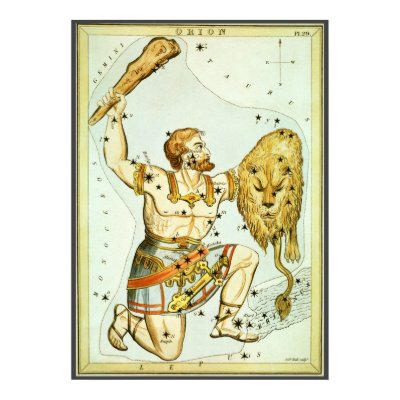 8) Orion: Orion was bestowed with the characteristics of the world’s greatest hunter. With a few different perspectives of the myth, his heritage changes somewhat, yet it is mostly agreed that whether his parents were Queen Euryale and Poseidon or the parentless gift to a lowly peasant from Zeus, Poseidon and Hermes, its mostly agreed that he was given the gift of incredible hunting skills, and some other skills that make him a bit ‘showy’ if you ask me (walking on water, incredible strength etc…). In any case, he was also said to have been a skilled blacksmith and to have built great temples to the Gods in his lifetime. Its also said that he had a bit of a fling with Artemis, the chaste God of fertility and the hunt. Two stories are told about this- one that Apollo, worrying for his sister’s chastity, tricked her into shooting Orion while he was at sea, killing him. Another version has Apollo simply sending a scorpion to kill Orion, which leads us to…the next blog!
 6) Hercules: Hercules, originally Heracles or Herakles, was ironically most greatly threatened in mythology by the wife of Jupiter, Juno (ironically because ‘Heracles’ can literally be translated as the ‘glory of Hera’, Juno’s Greek name). At birth, Heracles was beset upon by snakes sent by Juno into his crib as an act of vengeance for her husband Jupiter’s infidelity with a mortal woman. Easily strangling the twin snakes, this began Heracles career as a monster killer. He later married Megara who, as it was believed (possibly to retain Heracles’ heroic persona), was put under a spell of madness by Juno and killed Megara along with his own children. As atonement for these sins, however, he completes twelve necessary labours (one of which was of course the slaying of the Nemean lion…Leo!).
 7) Cassiopeia: If you’ve read the blogs before this one, you actually know a bit about this myth already! Cassiopeia is the mother of Andromeda- the same mother that bragged how her daughter (or herself, according to different versions) was more beautiful than the sea nymphs. As penance for her pride, she was forced to have her daughter strung up and fed to the sea monster sent by a vengeful Neptune, God of the Seas and of the sea Nymphs themselves. Enter Perseus, the saviour and future husband to the daughter of Cassiopeia. He saves Cassiopeia’s daughter and runs off with her to be married.
 4) Leo: Leo, the lion, is typically associated with the story of the Nemean lion faced by Heracles as one of his twelve labours. It was said that the skin of the Lion was perfectly impenetrable; therefore Heracles strangled the cat to death and subsequently used the creature’s own claws to skin the beast. Heracles is constantly depicted as having worn the skin of the Nemean lion on all of his adventures and seems to have been his key symbol apart from the club he bore as well. Leo is most recognizable in the night sky by the bright star Regulus, representing the supposed heart of the lion. The curved “sickle” makes up the Lion’s head, and the triangle towards his flank makes up the back portion of Leo.
 5)Draco: Draco, the snake (or dragon as it is sometimes depicted) has many originations, each of which is just as likely to be the true myth behind the constellation. Here, I’ll simply tell my favourite; the story of Cadmus and the founding of Thebes. Cadmus was given probably one of the most peculiar tasks of literally following a cow until the cow lay down, and here he was told to found the city of Thebes. Once reaching the site, however, his men were set upon by the ‘monster of Mars’. Mars being the god of war and perhaps the most violent of the Roman Gods, it’s understandable why the men were killed so quickly. Cadmus took up arms however and slew the dragon, planting its teeth in the ground (some of these myths are pretty crazy) from which sprung a legion of warriors to fight for Cadmus. They fought amongst themselves until there were but 5 soldiers left, and they, with Cadmus, became the first people of Thebes.
 1) Perseus: Slayer of the Gorgon Medusa, this character was born out of wedlock between his mother and the almighty God, Zeus (as were most heroes…and Gods…and Demi-Gods…and just about everyone). His mother’s Father seeing that she had been impregnated cast the pair of them out to sea in a wooden chest where they were rescued by a kind fisherman. Raised with the fisherman and his mother, the fisherman’s brother soon become attracted to the oh-so-handsome mother of Perseus. Perseus attempts to defend his mother, but is told the only way to save her from rape is to complete a series of impossible tasks to win her back. These include speaking with the Fates to learn of the location of the Gorgon Medusa, chopping off her head by use of a reflective shield, meeting up with the hearty Atlas, rescuing Andromeda from a sea monster sent by Poseidon and eventually returning to gain freedom for his Mother. he then fulfilled an old prophecy that he would kill his Grandfather, completely by accident, when he bopped him in the head with a discus.
 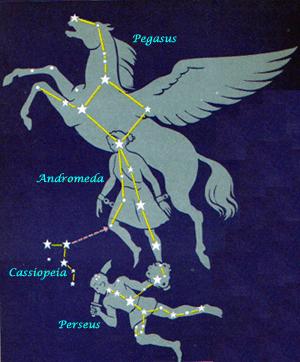 2) Pegasus: Alternatively, one might view the constellations as having this shape, where Pegasus is included. Pegasus was the winged horse, which is rumoured to have sprouted from the severed neck of the Gorgon once slain by Perseus. Pegasus was said to have one rider to whom he had an affinity; Bellerophon. Bellerophon was said to have been the first to tame and ride the first flying horse, and therefore he is often represented as being the ‘rider of Pegasus’. Other myths use a liberal amount of flying steeds however.
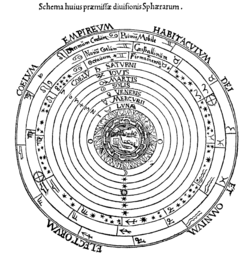 Not only do these explain Plato’s theory, but even within the myth itself lies a model for the cosmos. In the myth is described a ‘Spindle of Necessity’. It describes the cosmos as it is attended to by the Sirens and the Fates (if you’d like to know more about these mythical creatures- try having a gander at The Fates and The Sirens [scroll down to ‘Sirens’]). The model depicts the orbits of 8 celestial bodies, all corresponding to the Aristotelian planetary spheres. Although inevitably inaccurate, the model actually accurately represents their motion as it appears to someone on earth.
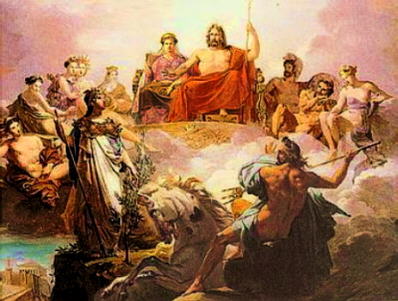 Let’s have a looksee at how these ancient Greeks and Romans devoted themselves to their Gods. Every action any man took in his life was made with the Gods in the forefront of their minds. Countless thousands upon thousands of animals were burnt and sacrificed to appease their Gods in times of war, famine and various times of misfortune. Fisherman blames themselves for having angered the God Poseidon after a storm at sea. With droughts they played to Zeus, Demeter and Athena to being them good crops. Hera was praised during weddings, and men killed each other because their enemy towns worshiped a God whom their God disliked. With such devotion to these powerful Gods and Godesses, I’m sure you can imagine why no one in their right mind would do anything to anger them. Who would offend a man with the power to strike you and your family with lightning, demolish your town with a tsunami or swindle you into committing adultery? Yet some dared.
 - Mercury. This Roman God was modeled after the Greek God Hermes, God of travellers and thieves; the messenger of the Gods. In this symbol we can see the wings from Hermes’ winged helm, which (along with his feathered sandals) enable him to fly.
 - Venus. Modeled after the Greek Goddess of love and vanity, Aphrodite. This symbol shows her hand mirror she used to admire her own reflection.
 - Mars. The God of war and destruction. Ares, his Greek equivalent, is represented here with his shield and spear with which he would fight in battle.
 - Jupiter. The King of the Gods, Zeus, is depicted here with his lightning bolt; a great symbol of his power in the classical period.
 - Neptune. Modeled after the great god of the sea, Poseidon, symbolically represented here by his trident- his symbol of power.