
Blog # 2- Plato and those silly lines….
So I figured (in keeping with the connection between Astronomy and a wee bit of Classics) I’d discuss the difficulties the ancient Greeks and Romans had with agreeing with the contemporary astronomers of their day.
First and foremost, in order to conceptualize this idea of a universe in the first place, someone had to have come up with the brilliant idea that the world was not created by the Gods (ie. Zeus and his earlier lineage), but that the earth could have come into existence all on its own. Thales was the very first to propose a model of the universe in which our existence didn’t rely on any omniscient, all powerful beings. Having lived from 624-546 BCE, one can imagine that this was an enormous step towards modernizing their concept of Earth and space.
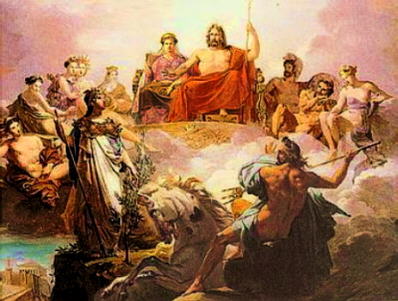 Let’s have a looksee at how these ancient Greeks and Romans devoted themselves to their Gods. Every action any man took in his life was made with the Gods in the forefront of their minds. Countless thousands upon thousands of animals were burnt and sacrificed to appease their Gods in times of war, famine and various times of misfortune. Fisherman blames themselves for having angered the God Poseidon after a storm at sea. With droughts they played to Zeus, Demeter and Athena to being them good crops. Hera was praised during weddings, and men killed each other because their enemy towns worshiped a God whom their God disliked. With such devotion to these powerful Gods and Godesses, I’m sure you can imagine why no one in their right mind would do anything to anger them. Who would offend a man with the power to strike you and your family with lightning, demolish your town with a tsunami or swindle you into committing adultery? Yet some dared.
The only problem here though is that every single person in existence in this particular area (ie. Ancient Greece) believed in these supernatural beings and that they had created life as they knew it. To objectify such a belief at this time was just about the most controversial and blatantly heretic way in which to offend every God-fearing man. This of course, is only the beginning to man’s travel to the belief and acceptance of such an enormously vast space as the universe.
Next, Pythagoras attempted to calculate (successfully) that the Earth itself is a sphere.
Then came the infamous Greek philosopher, Plato. To anyone who has read Plato’s Phaedo or any of his other works, they will understand why exactly Plato rejected the contemporary model of the universe so adversely.
A brief explanation of Plato’s beliefs:
- · There is a world of forms, which is not this world
- · In this world, nothing is divisible, and therefore everything is perfect
- · In our world, all matter is divisible, therefore imperfect
- · Within each being, however, lies a form that can subsist after death
- · In this world of forms, there are no lines, for in Heaven there are no lines, and therefore this world of forms is perfect
- · The world of forms exists outside of ours (ie. the Heavens)

With that briefest of brief explanations, hopefully you can grasp the general concept that Plato was all about the circles. Since everyone at this time believed that the space that lay outside of their realm of living was the sky, Plato asserted that everything belonging to that sky must be perfect circles.
This theory persisted for hundreds of years, with no one being daring enough to objectify the Gods and research other ways of stellar travel- those that are not perfect circles. Many philosophers and early astronomers came up with varying models that supported the celestial heavens moving in perfect circles, but it was not until Johannes Kepler, nearly 2000 years later thought of the ellipses to describe stellar motion that this theory was finally put to rest.
Although that was possibly the shortest of explanations as to the ideas of early astronomers, I hope it’s given a more sound idea as to why Plato’s theory of Heavenly circles remained in celestial models for so long.
-StarKid

0 comments:
Post a Comment