
So I know I said at the beginning that I would start the blog off with a bit of Classics, and then progressively get more ‘sciency’. Just never mind that. Its officially the Classics angle on Astronomy!
Since I’ve made this executive decision, I’ve decided to explain Plato’s concept of the cosmos a little deeper, as I feel as if that previous post was a bit to brief from my liking. Our best idea of his deeply rooted belief in the heavens and their operations come from, in my opinion, his famous work The Republic. More specifically, the conclusion of this piece. In this portion of his work, he described the ‘Myth of Er’, which is quite literally a myth about a man names ‘Er’ and his experience with the world of the heavens.
The story basically follows the man as he is killed in battle only to awaken on his funeral pyre, having visited the heavenly world. He tells of how he went to a place where men and women were separated upon death, some to go to the sky, and others to go deep underground to pay for their crimes in life (I could go on for ages and ages drawing similarities between Classical mythology, which existed hundreds of years earlier, and the Bible, but that would warrant an entirely new blog page). With much explanation as to the souls Er spoke with whilst dead, the story generaly tells of a Lady Necessity, the Sirens and the Fates (characters in Greek mythology) and their role as people chose their next life and were assigned Gods to help them live it. He then wakes up, about to be burned and tells his story.
It seems as if this is just an excuse for me to tell a neat story from Ancient Greece, but in fact the morals that philosopher’s see in this story (and Socrates explanations throughout its telling) tell us that this story supports and defines Socrates and Plato’s theory of the cosmos. First, that the soul is immortal as it never truly ends, only becomes something else. Therefore it is never able to be destroyed, and therefore perfect. Lines are jagged and have sharp edges, whereas circles are round and flawless. Therefore the heavens must be circles. Consequently, the stars and planets seen in the sky, since they belong to the heavens, must only move in perfect circles.
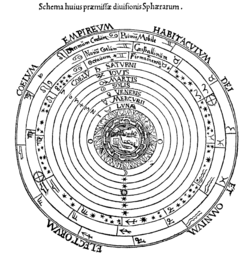 Not only do these explain Plato’s theory, but even within the myth itself lies a model for the cosmos. In the myth is described a ‘Spindle of Necessity’. It describes the cosmos as it is attended to by the Sirens and the Fates (if you’d like to know more about these mythical creatures- try having a gander at The Fates and The Sirens [scroll down to ‘Sirens’]). The model depicts the orbits of 8 celestial bodies, all corresponding to the Aristotelian planetary spheres. Although inevitably inaccurate, the model actually accurately represents their motion as it appears to someone on earth.
In any case, I hope this helps to make sense of my last post, and also provides a bit of entertainment and storytelling to your day J
-StarKid


 -
- -
-

